

The 1983 Guigal Côtes du Rhône that I took from my cellar the other day is an odd bottle only by virtue of its age. It was a modestly-priced wine when I purchased it, and recent vintages can be found pretty much anywhere and are still remarkably inexpensive.
The Côtes du Rhône AOC (Appellation d’origine contrôlée) is located in both the northern and the southern Rhône but mostly in the latter. In Wines of the Rhône, John Livingstone-Learmonth and Melvyn C. H. Master (oh, to have invented those names!) write, “Most Côtes du Rhône is an unpretentious country wine that is sometimes very good, sometimes very bad but nearly always pretty drinkable.”
Not so this one. Which is to say, “very good” doesn’t come close to describing just how wonderful it proved to be.
Guigal itself is located in Ampuis, in the northern Rhône, but it makes wine from appellations in both the north and the south. It is best known for its Côtes-Rotie, of which I recently drank a 1985 Brune et Blonde, which is Guigal’s least expensive Côtes-Rotie and may have been the best Rhône wine I’ve ever had. (A bottle of Guigal’s single vineyard Côtes-Rotie La Landonne may sell for nearly a thousand dollars, upon release.)
It’s almost always a good idea to buy an inexpensive wine from a winery that makes expensive wonderful wines — for example, the wine under discussion here or any of the three La Vieille Ferme (Rhône) wines from the Perrin family, who also make the renowned and much more expensive Chateauneuf du Pape, Beaucastel.
The Guigal Côtes du Rhône is always a blend of Syrah, Grenache, and Mourvedre. The 1983 most likely had more Grenache than Syrah, whereas more recent bottlings have more Syrah than Grenache.
The reason I had kept a presumably simple Côtes du Rhône for over thirty years is that I had drunk my other bottles of the same wine many years ago and had liked them very much. I knew 1983 was a great year in the Rhône and I decided I would just keep this one bottle around and check it out later…and later…and later.
Later is now (as it always, eventually, becomes).
I opened the wine. My first surprise was that the cork was in superb shape, both hard and supple, and I could even read upon it the boldly lettered “E. Guigal Ampuis Rhône.”
The wine had a golden-red hue, which I thought at first was more red than golden (but see below).
The full-blown nose was earthy, graphitic, and to me Italianate (which leads me to note that I so often think that red wines I particularly like might be, if I had to guess, Italian; sometimes I wish I were Italian).
The taste of the wine was fruity, tart, penetrating, and at first the tannins were almost teeth-coating, which was most surprising in so supposedly modest a wine, never mind a wine so old. (Oh, I thought at first, I’m drinking this much too young!—the wine, I mean, not myself.)
The wine was drunk with a beef stew. The two made each other very happy.
By the next day the wine had lost some of its verve. I didn’t think it had lost much color, until I poured next to it a 2007 Taverna Il Lagarino Di Dionisio (those Italians!), which is also a blend of three grapes, but in this case Merlot, Cabernet Sauvignon, and Aglianico. In contrast, my Côtes du Rhône now looked almost yellow.
My bottle of the 1983 cost $4.99 in 1985, which is about $11.00 today. And I found online several stores that are selling the recent vintages of the wine for almost exactly that! (Several weeks ago in France I saw the wine in a supermarket for a bit more, 11 Euros.)
Here’s wine writer Nick Passmore in a 2010 piece called “The Genius of Guigal’s Côtes du Rhône Rouge”: “…to make a wine of this quality, age it for two years, bottle it, ship it to the U.S. (and other markets), pay duty, distribution costs, wholesaler and retailer markup, and still sell it for $15 is not only extraordinary — it’s an act of winemaking genius.”
You’ll be able to find a recent vintage of this Guigal Côtes du Rhône. There are as many as 3,500,000 bottles made in any given year. That’s almost 300,000 cases.
Buy a case. If you drink only one bottle every three years, in 36 years you’ll have one left that will be about as old as this 1983. Lucky you.
Beef Stew with Wine

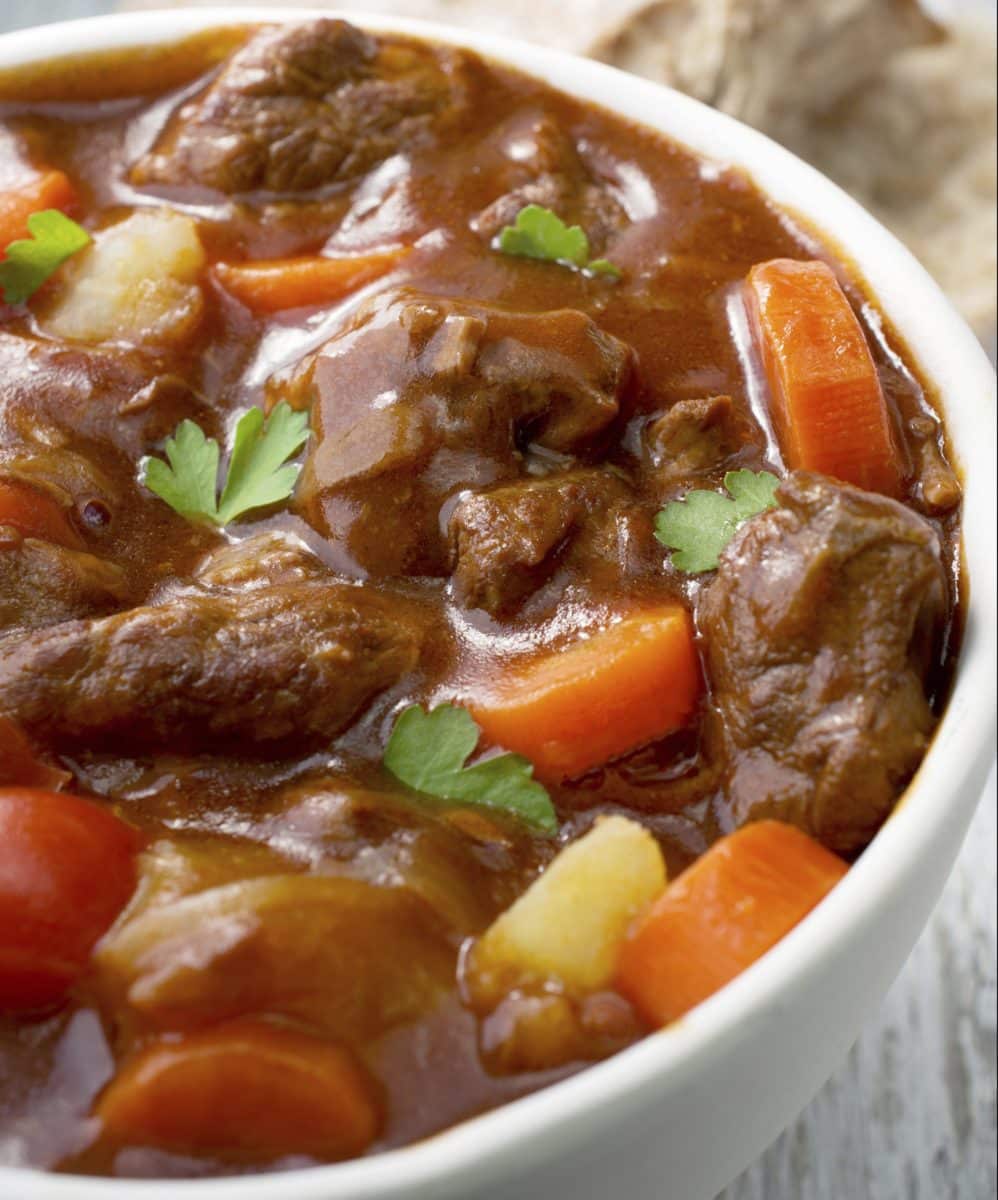
Ingredients
- •42 grams (⅓ cup) all-purpose flour
- •1 kilogram (2 pounds) boneless beef chuck, cut into 4 cm (1½ inch) cubes
- •Salt and freshly ground black pepper
- •45 ml (3 tablespoons) vegetable oil
- •3 large onions, chopped
- •1 liter (4 cups) beef broth
- •473 ml (2 cups) dry red wine
- •15 ml (1 tablespoon) Dijon mustard
- •30 ml (2 tablespoons) tomato paste
- •15 ml (1 tablespoon) veal or other demi-glace (available in specialty food markets), optional
- •5 ml (1 teaspoon) Tabasco or other hot sauce
- •2 large carrots, peeled and cut diagonally into 1-inch pieces
- •2 medium parsnips, peeled and cut diagonally into 1-inch pieces
- •60 ml (¼ cup) finely chopped parsley


Preparation
In a large bowl, combine the flour with 2.5 ml (½ teaspoon) each of salt and pepper, or to taste. Mix well, add the beef, and toss until coated.
In a large flameproof casserole over medium heat, heat the oil until shimmering. Add the beef cubes, shaking off any excess flour, and cook until well- browned on all sides. Remove from pan and set aside.
Add the onion to the pan and sauté until translucent, about 3 minutes. Add the broth, wine, mustard, tomato paste, demi-glace (if using) and Tabasco. Stir, scraping the bottom well. Add the beef and reduce heat to low. Cover and simmer, stirring occasionally, until beef is tender, about 2 hours.
Add carrots and parsnips and reduce heat to low. Simmer, partially covered, until vegetables are tender, about 30 minutes. Adjust salt and pepper to taste. Add parsley, and serve.